Alpha Decay: Why Your Trading Strategy Stops Working
Alpha decay is why your trading strategy stops working over time. Learn what causes it, how to spot it early, and why most guru strategies a scam

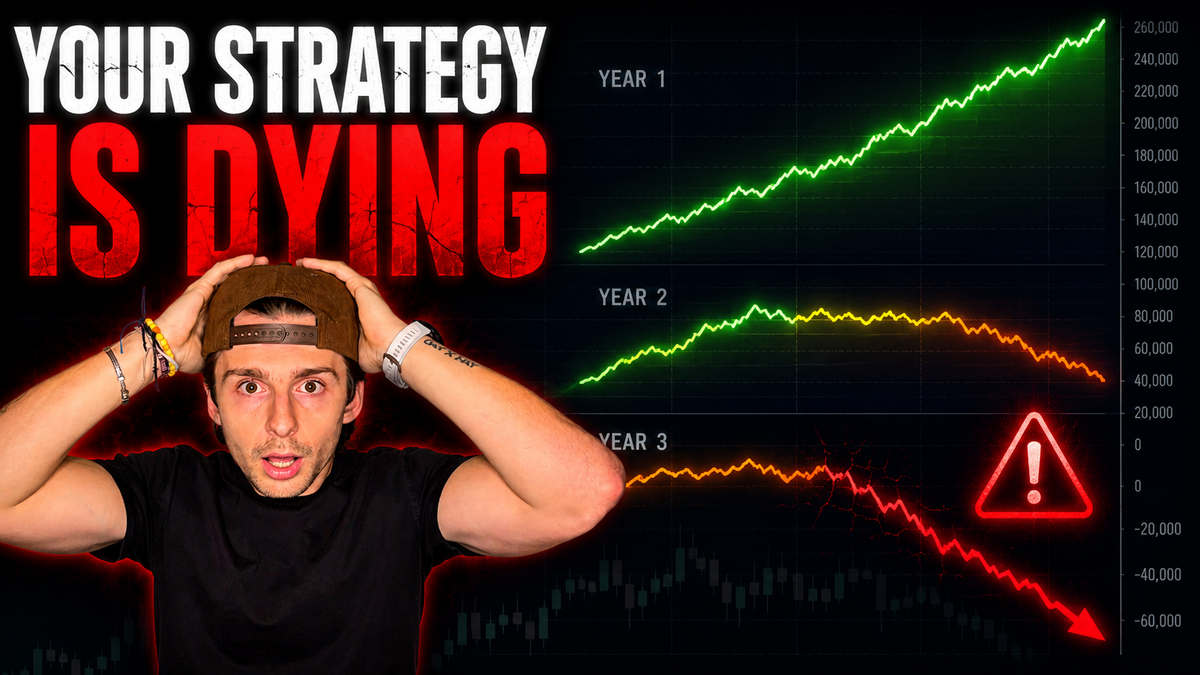
You found a trading strategy. You back tested it. The numbers looked great. You started trading it live, and for a while it actually worked — until the wins started shrinking, the edge began draining, and eventually you were left wondering if you ever had anything to begin with. That's not bad luck. That's not a fluke. And it's almost certainly not you doing something wrong. It's a concept called alpha decay, and if you don't understand it, it's quietly working against you every single day.
By the end of this article you're going to know exactly what alpha decay is, why it happens, why it's accelerating faster than ever, and the part most people won't tell you — why every trading guru selling a strategy online is unintentionally proving this concept the moment they hit publish.
Key Takeaways
- Alpha is the excess return a strategy generates above the market — alpha decay is when that edge erodes over time, even if nothing about the strategy itself has changed.
- Research from Maven Studies estimates alpha decay costs traders roughly 5.6% annually in US markets and nearly 10% in European markets, with the rate accelerating each year.
- The three biggest accelerants of decay are faster technology, near-zero trading costs, and the speed at which strategies now spread on YouTube, Reddit, and Discord.
- If a strategy genuinely produced consistent alpha, the rational move is to scale it — not sell it. The act of selling a strategy is what kills it.
- The traders who last build their own edge, study frameworks instead of setups, and accept that strategy research is a continuous process — not a one-time discovery.
What Is Alpha?
Before we can talk about decay, we need to define alpha. In trading and quantitative finance, alpha is the excess return a strategy produces above the market benchmark. If the S&P 500 returns 10% in a year and your strategy returns 17% with similar risk, the extra 7% is your alpha. That's your edge — the part of your performance that isn't explained by just being long the market.
Here's the catch: alpha only exists because of an inefficiency. A pricing error, a behavioral pattern, a structural quirk in how the market is operating. If markets were perfectly efficient, alpha wouldn't exist at all. Your strategy is finding that inefficiency and exploiting it before the market corrects.
What Is Alpha Decay?
Alpha decay is the gradual erosion of that excess return over time. A strategy that returned 20% per year at launch might quietly drift down to 18%, then 16%, then 14%, and eventually break even. Nothing about the strategy itself has changed — the market around it has.
The term actually borrows from physics. In nuclear physics, alpha decay is when an unstable radioactive atom expels particles to stabilize itself. It breaks down over time and eventually becomes inert — stable, but no longer reactive, no longer powerful. Trading strategies do the exact same thing. They might start off generating clear edge by exploiting specific market conditions, then slowly lose that edge until they become essentially powerless. At that point, you'd be better off just buying and holding the S&P than executing the strategy at all.
This isn't a theoretical concept. Researchers at Maven Studies documented it directly — they found alpha decay costs traders roughly 5.6% annually in US markets and nearly 10% in European markets, and those costs are accelerating year after year. In their study, even delaying a signal by a few seconds — not hours, not days, literally seconds — was enough to wipe out a trade's entire edge at the institutional level. The same principle applies to every retail trader using strategies found online.
Why Alpha Decay Happens
Alpha exists because of a market inefficiency. The moment more participants start exploiting that same inefficiency, the market corrects faster, the edge gets split across more traders, and the inefficiency shrinks. Eventually there's nothing left to capture.
Here's the simplest way to think about it. Imagine you find a $20 bill on the sidewalk. That's your alpha. Now imagine you tell ten friends where it is. They each tell ten more people. By the time you walk back to grab it, not only is the $20 gone — there are 200 people standing in the same spot looking for it. The bill didn't disappear because you did something wrong. It disappeared because it became well-known. In trading, this is called a crowded trade.
Three Forces Accelerating Decay
1. Faster Technology
Markets are faster than they've ever been and only getting faster. Information gets priced in almost immediately. A signal that used to last days or weeks might now last hours — or minutes. The window for a retail trader to act on any publicly known edge keeps shrinking.
2. Near-Zero Trading Costs
When commissions dropped to zero across most US brokers, the barrier to participation dropped with them. More traders are flooding in, chasing the same patterns, compressing edges that used to take much more capital to access.
3. The Speed of Information
Between YouTube, Reddit, Discord groups, TradingView strategies, and the endless market of trading courses, strategies now spread faster than they ever have. The moment a pattern starts going viral is the moment it starts to die. It's a feedback loop that almost guarantees decay.
The Trading Guru Problem
This is where alpha decay connects to something every trader has seen but maybe never thought about clearly. You know the guys. They're on YouTube, Instagram, TikTok — they've got the screenshot P&Ls, the screen recordings, the Lamborghini thumbnails. They're almost always selling a strategy, a course, a mentorship, or a signal group. The pitch, boiled down, is some version of: "I have found a strategy that beats the market. I'll teach it to you for $297 a month."
Sit with that for a second. If a strategy genuinely, consistently generated meaningful alpha — an edge that beats the market over time — why would anyone sell it? It's not a trick question. If you owned a machine that printed money, you wouldn't sell the blueprint unless you believed the blueprint was more profitable than the machine itself. You'd find every possible way to scale the capital running through that machine. You wouldn't post it on YouTube for free. You sure as hell wouldn't package it into a course and hand it to thousands of people who can use it, share it, and tell their friends about it.
And here's the kicker: even if the strategy was legitimately profitable at the time someone started selling it, the simple act of teaching or selling it is what kills it. Every new person in the group, every buyer of the course, is crowding the same trades and decaying the quality of the setups. You can argue most students won't follow the rules perfectly, and that's fair — but the directional pressure is unmistakable.
Researchers from S&P have documented this directly. They call it the alpha life cycle: discovery, early adoption, crowding, decay. The moment a strategy enters the crowding phase — the moment it becomes widely known — measurable returns start declining. That's not speculation. It's an observed and documented phenomenon across markets.
So what's the actual business model of these gurus? It's not trading. It's selling the idea of trading. The profit center is the course, the signal group, the coaching program. To be fair, not all of them are malicious — some genuinely believe in what they're selling and want to share what's worked for them. But your intentions don't override market mechanics. Alpha decay doesn't care how confident you are or how much you want your students to win.
What To Actually Do About It
1. Be Skeptical of Widely Shared Strategies
The more popular a concept gets, the less edge it likely contains. ICT concepts are a clean example — millions of followers, millions of views, countless videos and courses. Some of it may still work, but almost certainly not nearly as well as it did for the people who discovered or popularized those ideas first.
2. Think About Strategy Half-Life
Every trading strategy has a lifespan. Some last decades, some last weeks. The dip-buying approach in the broader market is something I've been thinking about a lot. Over the past two decades, buying dips — especially the sharper ones in COVID, 2022, the April 2025 selloff, and the spring 2026 pullback — has produced incredible results. The more obvious that becomes, the more capital flows into the exact same playbook. At some point, that edge becomes far less reliable than it has been. Knowing this in advance doesn't make you immune, but it does make you watchful.
3. Learn Frameworks, Not Setups
If you're going to learn from someone, learn the frameworks — risk management, position sizing, psychology, how to build, test, and stress-test a strategy, how to track and optimize it. Those are the durable skills. The specific entry rule someone is teaching you will decay; the ability to develop and validate your own ideas won't.
4. Develop Your Own Edge
When you build your own edge, you're in control. You know your strategy inside and out. You're not relying on someone else's interpretation of the markets, and you're not telling the world what you're doing. You're the one watching it, optimizing it when conditions shift, and deciding when it's no longer worth running. That's the closest thing to a sustainable trading career that exists — and it's what every successful systematic trader I know actually does.
Frequently Asked Questions
What is alpha decay in trading?
Alpha decay is the gradual erosion of a trading strategy's excess returns over time. A strategy that consistently beat the market when it was first developed will slowly lose that edge as more participants discover and trade it, market conditions shift, or the underlying inefficiency the strategy exploited gets priced away.
How long does a typical trading strategy last?
It varies wildly. Some statistical arbitrage strategies decay within months. Trend-following systems based on decades of data have lasted 30+ years, though with far lower returns than they produced in the 1980s. Most retail-accessible strategies have a useful life measured in months to a few years, depending on how widely known they become.
Why do trading gurus sell their strategies if they actually work?
Because in almost every case, the strategy is either no longer producing meaningful edge, was never producing the edge they claim, or the seller has realized that selling the strategy is more profitable than trading it. If a strategy genuinely produced consistent alpha, the rational decision would be to scale capital into it — not distribute it to thousands of new participants who will only crowd the trade.
Can I avoid alpha decay completely?
No — for almost any strategy a retail trader can build, decay is inevitable. The exceptions are edges built on structural advantages most participants can't replicate, like speed, capital, regulatory access, or proprietary data. What you can do is monitor for it, build your own edges instead of copying widely shared ones, and treat strategy research as a continuous process rather than a one-time discovery.
Is alpha decay the same thing as a drawdown?
No. A drawdown is a temporary decline in equity that's statistically consistent with how the strategy has performed historically. Alpha decay is structural and persistent — the strategy's expected return has actually shifted lower, not just delivered a bad streak of outcomes.
How do professional quants deal with alpha decay?
They assume it. Top quant funds typically run dozens or even hundreds of strategies simultaneously, each contributing a small slice of alpha. When one decays, it gets retired and replaced. They treat strategy generation as an industrial process, not a one-time event — which is the same mindset retail traders should adopt at a smaller scale.
Final Thoughts
Alpha decay is one of those concepts most retail traders never even hear about, but it's working against them constantly. Every time someone follows a popular strategy, joins a crowded signal group, or buys a course about "the setup that always works," they're a participant in their own alpha decay. The market doesn't reward what's popular — it rewards what's early.
The traders who build sustainable careers aren't the ones who find one magic system. They're the ones who accept decay, monitor for it relentlessly, and stay in the research seat permanently. If you want a place to track your trading data and start identifying which of your edges are working — and which are quietly fading — check out Tradezella. It's where I analyze every one of my trades.