The Real Problem With Agentic Trading
Agentic trading sounds easy and passive—but Robinhood tutorials skip the rising tide trap and why backtesting your strategy is non-negotiable.

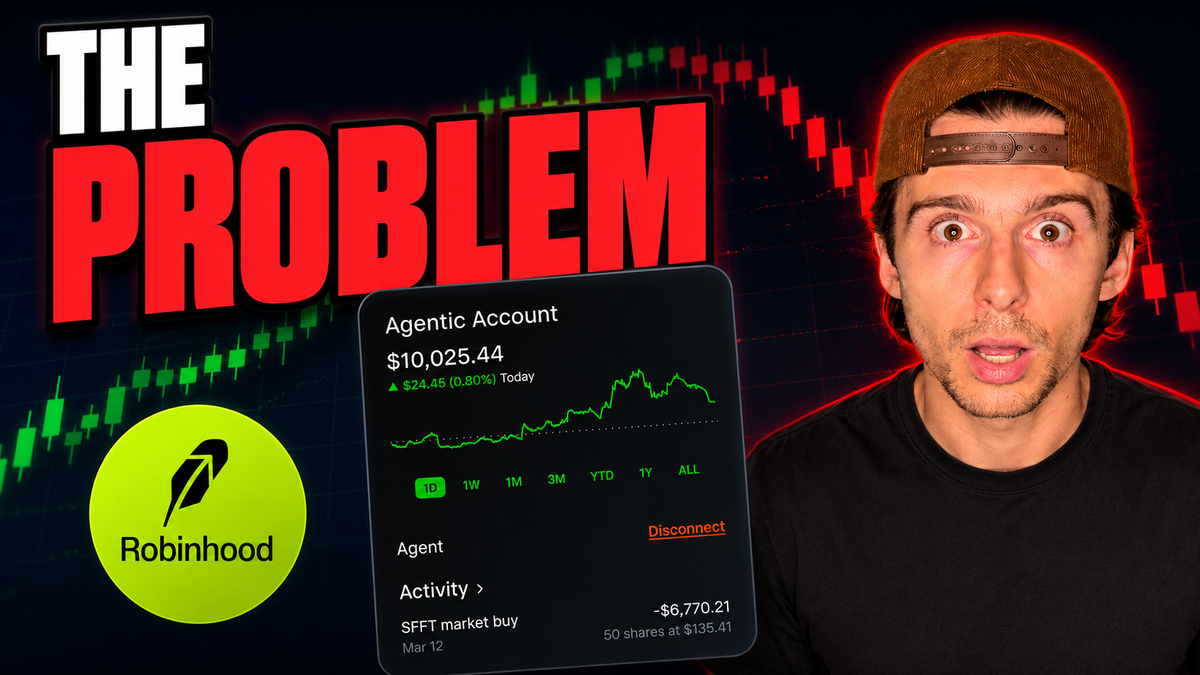
Agentic trading is exploding right now, and the pitch is almost too good to resist: connect an AI agent to your brokerage, set it up in minutes, and let it place every trade for you while you do nothing. Robinhood built an agentic platform straight into its app, Webull connections are live, and traders everywhere are wiring up TradingView. But there is a huge amount that the "set it up in 5 minutes" tutorials leave out — and skipping it is how people quietly lose money.
Here's the direct answer up front: agentic trading is only as good as the strategy behind it, and most people have no idea whether their strategy actually works. A rising market can make a mediocre agent look brilliant, and without backtesting and validation you're essentially trading blind. This article breaks down the two biggest problems no one is talking about, when agentic trading genuinely shines, and exactly what you need to do before you let an AI agent touch your live funds.
Table of Contents
- What Agentic Trading Actually Is
- Problem #1: The Rising Tide Illusion
- When Agentic Trading Actually Shines
- The Real Unlock: Removing Emotion
- Problem #2: You Don't Know How Your Strategy Will Perform
- Why Backtesting Is Non-Negotiable
- Beyond a Basic Backtest: Monte Carlo and Validation
- A Real Example: From Backtest to Monte Carlo
- Is Agentic Trading Worth It for You?
- Frequently Asked Questions
- Conclusion
Key Takeaways
- Agentic trading lets an AI agent place trades for you automatically once your criteria are met — Robinhood, Webull, and TradingView connections have made setup trivial.
- A rising market hides bad strategies. If your agent just buys Apple, SPY, or QQQ on dips, you may simply be riding the "rising tide," not adding real edge.
- The real value appears when you build a genuine strategy that can beat the S&P 500, hedge downturns, or make money in any environment — powered by AI research and data at a scale humans can't match.
- Removing emotion is the biggest unlock. Automation removes the impulsive "close enough" trades that sabotage most traders.
- The largest hidden problem: you don't know how your strategy will perform in the future. Backtesting and Monte Carlo validation are how you stop trading blind.
- Never risk live funds on an unvalidated strategy. Backtest it, check for overfitting and repainting, and run a Monte Carlo analysis first.
What Agentic Trading Actually Is
Agentic trading means handing execution over to an AI agent. You define the logic — the conditions, the assets, the rules — and the agent watches the market and places trades on your behalf when everything lines up. No more sitting at the screen waiting for a setup.
The barrier to entry has collapsed. Robinhood now offers agentic trading inside the app, and connecting an agent to a brokerage like Webull takes only a few minutes. Because it's so easy, nearly every trading channel is racing to publish "here's how to set it up" tutorials. The setup genuinely isn't hard — but setup is the easy part. What matters is what your agent is actually doing with your money.
Shorting is slowly rolling out across platforms, and it's reasonable to expect futures, crypto, and essentially everything tradeable to eventually be operable by AI agents. The capability is expanding fast. The judgment behind it is not.
Problem #1: The Rising Tide Illusion
The first problem is what we can call the rising tide problem — a rising market lifts almost everything, which makes it dangerously easy to mistake a bull market for skill.
Look at the numbers. Going back to the 2025 lows, the S&P 500 has bounced back over 50% in barely a year. Measured from the start of 2025 to late July 2026 — about a year and a half — the index is up roughly 25%. For context, the average market return over the past 100 years is about 10% per year. So simply buying and holding SPY, the S&P 500 ETF, has beaten the long-term average handily over this stretch.
Individual names tell a similar story. Apple is up around 28% from late 2024 to now, actually beating the S&P 500 over that same span. So here's the uncomfortable question: if you set up an agent to "buy SPY, buy Apple, buy Nvidia on the dip," what have you really built?
In most cases, nothing new. You're doing the exact same thing you could do manually — or with a recurring buy you could have set up years ago. Automating it can be convenient, since your computer calculates the entry conditions instead of you. But if that's the whole strategy, it isn't an upgrade. It's a dressed-up recurring purchase, and the returns are coming from the market, not from your agent.
When Agentic Trading Actually Shines
Agentic trading gets genuinely powerful when you go deeper than "buy the dip on Apple." The real opportunity is building an automated strategy that doesn't just track the market.
Imagine a strategy that:
- Trades whatever you choose — SPY, Apple, Tesla, Amazon — long, and eventually short as shorting expands across platforms.
- Beats the S&P in bull markets by capturing more upside than buy-and-hold.
- Hedges downturns, losing less than the index through a full drawdown.
- Or, in the ideal case, makes money in all environments — profitable in bull markets, profitable in bear markets, and outperforming the S&P and Nasdaq when you average it all out.
None of that is easy. But the way AI now integrates into a strategy is what makes it compelling. An agent can do the research for you, pull and read enormous amounts of data in seconds, and surface insights you couldn't process manually. Package that information, feed it into your strategy, and you've gained a capability you simply didn't have before. If it produces consistent profit, that is when you're actually reaping the benefits of agentic trading — in a lucrative, sustainable way rather than just riding a bull market.
The Real Unlock: Removing Emotion
Pair all that data, research, charting, and statistical modeling with one more thing — the removal of emotion — and you have the true unlock.
When your agent trades, you're not the one clicking the button. Either the criteria are all met and it acts, or they aren't and it does nothing. Compare that to how you and I actually trade: "It has this, it has this, it has this… it doesn't quite have that, but it's close enough. I'm bored, I'm going long." We've all done it. That impulsive, emotional decision-making is exactly what holds most traders back.
Automation strips that out. The creativity lives in the strategy you design; the execution stays disciplined and unemotional. But — and this is critical — the moment you solve the emotion problem, you've created a brand-new one.
Problem #2: You Don't Know How Your Strategy Will Perform
Say you did the work. You built clever logic, you have a strategy meant to beat the market and make money while you sleep. You switch on the agent. It's green for a couple of weeks, the market's climbing, you're happy — maybe even beating the index.
But how do you know that continues? You don't.
This is, arguably, the single largest problem in the entire agentic scene that almost no one talks about: you have no idea how your strategy will perform in the future. You don't know what's coming — what wars start, what conditions hit, whether markets chop, trend, or roll into a deep bear market. Will your strategy survive those conditions? Without evidence, you're guessing.
Left unaddressed, this turns "passive income" into an anxiety machine — a strategy you check constantly because you can't rely on the performance you're seeing. Setting up an agent on a Tuesday afternoon and calling it passive income is a fantasy if you never validated the engine underneath it.
Why Backtesting Is Non-Negotiable
This is exactly why backtesting is crucial. Backtesting won't tell you the future, but it tells you whether your strategy has ever actually worked — and trading without that is doing the whole agentic thing blind.
The good news: the tools are more accessible than ever.
- TradingView has a built-in backtesting feature, ideal if you already use it for charting.
- TradeZella recently added a backtesting feature of its own.
- If you're determined, you can even backtest through your AI platform of choice — it takes some figuring out, but it's possible.
The principle is simple: nothing should trade your live funds until you've backtested it. In serious automated trading, a strategy earns its way to real money by proving it has worked historically and by surviving deeper statistical scrutiny — at a minimum, a Monte Carlo analysis.
Beyond a Basic Backtest: Monte Carlo and Validation
A single good-looking backtest is not enough. Once you have one, the real questions begin:
- Is it overfit? Did you curve-fit the strategy to past data so tightly that it won't generalize?
- Is the backtest repainting? Are signals quietly changing after the fact, making results look better than reality?
- Did you Monte Carlo it? Reshuffle the trade order and stress-test thousands of possible sequences?
- Did you diversify? Multiple strategies blended together, multiple assets, proper diversification?
These aren't academic. Overfitting and repainting are the two most common ways a "profitable" backtest turns into a losing live account. If you already use TradingView, it's worth understanding repainting and curve fitting specifically so you can spot them while you test.
Backtesting, Monte Carlo simulation, probability-of-ruin analysis — this is the exact work hedge funds have done for decades. What's changed is that it's finally becoming accessible to individual traders. Ignoring it is choosing to compete at a massive disadvantage.
A Real Example: From Backtest to Monte Carlo
Here's how this looks in practice with a real workflow.
Start with a backtest in TradingView — say a swing trading strategy on Bitcoin that, in theory, doesn't repaint. Because it's a swing strategy, it doesn't trade often. Over roughly 10 years, the backtest shows the account up about 700%. Amazing on paper.
Now take it further. Export the strategy's results as an XLSX file and run them through a dedicated analysis engine — in this workflow, a purpose-built tool called QuantGrip. You can even add prop-firm settings if you trade prop accounts, plus advanced options for extra detail. The engine then runs a Monte Carlo shuffle and a bootstrap analysis, surfacing:
- Probability of ruin
- A detailed final equity curve
- Max drawdown
- Win streaks and losing streaks
- The Monte Carlo paths — every potential trajectory your strategy could have produced
Those paths are the real prize, not the shiny 700% headline. A single backtest shows one history. The Monte Carlo shows the cloud of outcomes you could realistically have experienced instead. And the bootstrap tells the same cautionary story: even for a genuinely profitable strategy, some paths sit below the $10,000 starting balance for as long as 60 trades — which, on a strategy that trades only about 10 times a year, is years underwater. That's the reality a lone backtest hides.
You don't need this specific tool — you can code your own version if you want. The point is the discipline: understand what the strategy does, then validate it with real data before your agent ever risks a dollar.
Is Agentic Trading Worth It for You?
So, is agentic trading worth setting up? It depends entirely on how you use it.
- If you're just automating dip-buys on Apple or SPY: It's convenient, but it's not a meaningful upgrade over a recurring buy. Your returns are mostly the market's returns.
- If you're building a real, validated strategy: This is where agentic trading thrives — combining AI-driven research, disciplined emotionless execution, and rigorous backtesting into something that can genuinely aim to beat the market.
The automation is the easy, exciting part. The plan and the engine behind it are what separate a sustainable edge from an expensive experiment. Build those, and agentic trading becomes a genuine advantage. Skip them, and you're setting yourself up for failure with something that only sounds great on paper.
Frequently Asked Questions
What is agentic trading?
Agentic trading is when an AI agent automatically places trades on your behalf based on rules you define. You set the conditions and assets; the agent monitors the market and executes when your criteria are met — removing the need to manually place each trade.
Is Robinhood's agentic trading worth using?
It can be, but the platform isn't the deciding factor — your strategy is. Robinhood makes setup easy, yet an agent running weak logic (like simple dip-buying in a bull market) won't outperform a basic recurring buy. The value comes from a validated strategy, not the connection itself.
Why isn't buying SPY or Apple with an agent a real strategy?
Because a rising market lifts most assets. Over the recent stretch, SPY is up around 25% and Apple around 28% just from buying and holding. An agent replicating that isn't adding edge — it's riding the "rising tide" and calling it skill.
What is backtesting and why does it matter?
Backtesting runs your strategy against historical data to see how it would have performed. It doesn't guarantee future results, but it's the minimum evidence that your strategy has ever actually worked. Trading a strategy live without backtesting it is trading blind.
What is a Monte Carlo analysis in trading?
A Monte Carlo analysis reshuffles your trade order across many simulations to reveal the range of outcomes your strategy could produce — not just the single path a backtest shows. It exposes risks like probability of ruin and deep drawdowns that a single backtest can hide.
What are overfitting and repainting?
Overfitting (curve fitting) means tuning a strategy so tightly to past data that it fails on new data. Repainting means a backtest's signals change after the fact, making results look better than they really were. Both make a strategy look profitable when it isn't.
Can I backtest without special software?
Yes. TradingView has built-in backtesting, TradeZella recently added a backtesting feature, and you can even backtest through an AI platform with some effort. Dedicated engines add deeper analysis like Monte Carlo and bootstrap testing on top.
Is agentic trading truly passive income?
Not by default. Without validation, it can become an anxiety machine you check constantly because you can't trust the performance. It only approaches "passive" once you've built and rigorously tested the strategy driving it.
Conclusion
Agentic trading is one of the most exciting shifts in retail trading — AI can now research, analyze, and execute at a scale we simply couldn't before, all without the emotional mistakes that wreck most accounts. But the automation is the easy part. The rising tide can flatter a weak strategy, and no live performance means anything until you know how your strategy behaves under pressure.
Before you let an agent trade a single dollar of real money: understand the strategy, backtest it, check for overfitting and repainting, and run a Monte Carlo analysis. Do that work, and agentic trading becomes a real edge instead of a blind gamble. The potential at your fingertips is genuinely endless — just don't play the game at a massive disadvantage.
If you found this helpful, subscribe to TC Trading for deep dives on backtesting, automated strategies, and building trading systems that actually hold up. Drop your questions in the comments, and start building the engine behind your automation today.
Watch the full video here: