Kalshi World Cup 2026: How To Trade Every Game Legally
How to trade the 2026 FIFA World Cup on Kalshi — markets, contract pricing, mid-game exits, and the maker/taker fees explained.

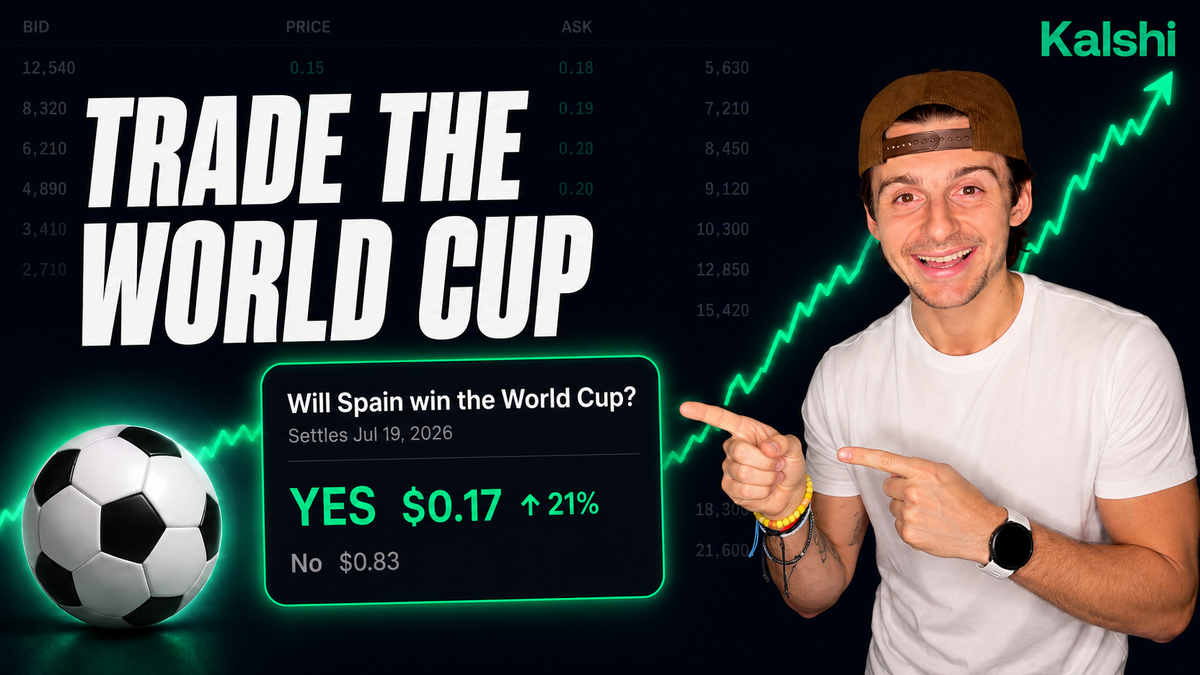
The 2026 FIFA World Cup kicks off on June 11th with 48 teams, 104 games, and the final at MetLife Stadium on July 19th — the biggest soccer match ever held in the United States. And for the first time in history, you can legally trade the outcome of every single game from inside the US.
It's not a sportsbook. It's not a casino. Kalshi World Cup 2026 markets are federally regulated event contracts where you trade against other users in real time, with prices that move during the match. If you've ever bet on a game with a traditional book, this is going to look familiar on the surface — but underneath, the mechanics are very different.
By the end of this article, you'll know exactly what's tradable on Kalshi for the World Cup, how event contract pricing actually works, the difference between maker and taker fees (which most articles get wrong), and how to exit a position mid-game without waiting for the final whistle.
Key Takeaways
- Kalshi is a federally regulated prediction market with CFTC oversight — the same regulatory status as the CME, not a sportsbook.
- Every World Cup contract is a binary yes/no question that settles at $1.00 if the outcome happens or $0.00 if it doesn't, with prices moving between 1 cent and 99 cents in the meantime.
- Kalshi currently has 314 markets for the FIFA World Cup, covering match winners, group advancement, tournament winner, third-place finisher, and dozens of specialty props.
- Unlike a traditional sportsbook, you can exit a Kalshi position mid-game — the price moves live as goals are scored, players get hurt, or momentum shifts.
- Taker fees range from roughly 7 cents to $1.75 per contract; maker fees (resting limit orders) are dramatically lower because you're providing liquidity.
- Fees are highest when markets sit near 50/50 odds and lowest when one side is heavily favored — a function of how Kalshi's fee formula is structured around uncertainty.
What Kalshi Actually Is
Kalshi is a federally regulated prediction market exchange. It holds CFTC regulatory status — the same agency that oversees the CME and the futures and commodities markets. That distinction matters: Kalshi is not a sportsbook, not a casino, and there's no bookmaker setting the odds.
When you look at a market on Kalshi, the "odds" you see aren't lines a house is offering. They're prices that represent the percentage chance the broader market currently believes the outcome will happen. Every market is essentially a live, two-sided order book — exactly like a stock exchange — with bids and asks set by the traders themselves.
That's the fundamental difference. On a sportsbook, you bet against the house at a fixed line. On Kalshi, every trade you make has another user on the opposite side, and prices move continuously based on what those users are willing to pay.
How World Cup Event Contracts Work
An event contract is a binary instrument. The outcome resolves as either yes or no — it either happens or it doesn't — and the contract settles at one of two values:
- $1.00 if the outcome occurs (settlement price)
- $0.00 if the outcome doesn't occur (settlement price)
Between now and settlement, those contracts trade between 1 cent and 99 cents based on the perceived probability of the outcome. As the situation changes — a goal is scored, a player gets injured, the weather shifts — those probabilities update in real time, and so does the price.
Take the opening match: Mexico vs South Africa, June 11th at 3:00 PM Eastern. As I'm writing this, the market is pricing in:
- 70% chance Mexico wins
- 11% chance South Africa wins
- 20% chance the match ends in a tie
The ROI on Mexico is showing 1.4x — meaning $1 in returns $1.40 if Mexico wins, before fees. That number is just the inverse of the price: if you're paying 70 cents for a contract that pays out $1, you're getting roughly 1.4x on your money if you're right.
The cleanest part of all this is that your maximum risk is always known upfront. If you put $5 on Mexico to win, the worst case is losing that $5. That's it. There's no parlay-style cascading loss, no liability that grows as the game unfolds. You can only lose what you paid for the contract.
What You Can Trade On The 2026 World Cup
Kalshi currently has 314 markets open for the FIFA World Cup as I'm filming this. That number will move around as the tournament progresses, but the categories are worth knowing because they're each priced differently and reward different kinds of analysis.
Tournament Winner
Pick which country wins the whole thing. Each country's contract is priced by their current probability — favorites trade at higher prices, longshots at lower prices. Kalshi also has a pick the winner promo with a $1 million prize pool that gets split across everyone who picks the correct champion (this part is a free entry, separate from the actual tradable contracts).
Group Stage Advancement
Each group has its own market for which teams advance. A maximum of three teams from each group can move on. For Group D, the United States is currently the favorite to win the group, with Turkey close behind. There's an 85% chance the US advances out of the group stage — meaning a $1 bet returns $1.15 if it happens.
Game-Level Markets
Every single one of the 104 matches has its own market for win, loss, or tie. These are the markets that move the most during live games.
Futures And Stage Markets
This is where it gets interesting beyond the obvious. You can trade:
- How far a specific team will advance (round of 16, quarterfinals, semifinals, etc.)
- Furthest-advancing nation from a region — like the furthest-advancing Asian or Oceanic nation, currently Japan vs the Korean Republic
- Third-place finisher
- Specialty props on individual players and teams
World Cup Props
The prop category covers things outside game outcomes — like whether specific players make their country's World Cup squad, or whether Iran competes in the World Cup. That last one is a good example of how dramatically these markets can move: the odds of Iran competing were under 20% a few months ago and are now sitting above 90%. Anyone who traded yes early caught a serious move.
Kalshi Vs A Traditional Sportsbook
| Kalshi | Traditional Sportsbook | |
|---|---|---|
| Regulator | CFTC (same as CME) | State gaming commissions |
| Who you trade against | Other users on the exchange | The house / bookmaker |
| Odds | Live, market-driven, two-sided | Fixed lines set by the house |
| Mid-event exit | Yes — sell anytime, just like a stock | Limited cash-out options |
| Pricing mechanic | Probability-based, $0.01 to $0.99 | American/decimal odds, spreads, totals |
The mid-game exit is the part that most former sportsbook users find genuinely useful. On a traditional book, once you've placed a wager, you're locked in until the game ends. On Kalshi, you can sell your position any time before the contract settles — letting you trade momentum swings the same way you'd trade a stock during the day.
How To Place A World Cup Trade On Kalshi
- From the Kalshi homepage, navigate to the Sports tab — or search "World Cup" in the search bar to skip ahead.
- Under Sports, scroll down to Soccer and select FIFA World Cup.
- You'll land on the main World Cup hub showing all 314 markets, broken into tabs for Games, Group Stages, Futures, Group Stage Props, and World Cup Props.
- Click into the specific market you want to trade.
- Choose your outcome (e.g., a specific team or "tie") and click Yes to buy or No to sell against it.
- Enter either a dollar amount or a number of contracts. Kalshi will show you the current odds, max payout, and any fees built into the trade.
- Click Review and Buy, confirm the details, and submit.
Concrete example from the platform. Trading the United States to advance out of Group D at 85% odds, I put in a $5 trade. The order ticket shows the odds, the cost, a fee of 6 cents, and a max payout of $5.81 if the US advances. One click to submit and the position is live.
Another one. The World Cup third-place finisher market just launched — everyone is fixated on the winner, but third place is its own contract. I traded Brazil at 11%. A $5 entry returns a max payout of $42.72 if Brazil finishes third. That's roughly 8x on the trade if it hits, because the probability is genuinely low.
How To Exit A Position Mid-Game
Once you're in a position, your current ROI shows live based on how the price has moved. To exit early:
- Click into the market your position is in.
- Instead of clicking Yes (to buy more), click No — which functions as selling your current position rather than betting against it.
- Choose how many contracts to close and at what price (market or limit).
- Review and submit.
If the price has moved in your favor, you lock in profit. If it's moved against you, you take a smaller loss than waiting for full settlement. The flexibility matters more in fast-moving game markets than in long-dated futures — but it's available on every contract.
One thing to be aware of: exiting early means paying fees on the exit too. If you paid 1 cent in fees when you entered and you close before settlement, you'll pay fees again on the way out based on the same fee formula. It's not a reason to avoid early exits, but if you're an active trader, those round-trip fees add up.
Kalshi Fees Explained
Kalshi's fee structure is the part most people gloss over. Here's the actual math.
Taker Vs Maker Fees
Kalshi uses the same maker/taker model you'd see on a crypto exchange or a stock ECN:
- Takers use market orders — you're getting filled immediately at the current best price. Fees are higher because you're consuming liquidity.
- Makers use resting limit orders — you set a price and wait for someone to fill it. Fees are dramatically lower because you're providing liquidity that keeps the market functioning.
For most markets, taker fees fall in a range of 7 cents to $1.75 per contract. Maker fees are substantially lower.
The Taker Fee Formula
The taker fee is calculated like this:
Fee = round_up(0.07 × C × P × (1 − P))
Where C is the number of contracts and P is the price of the contract in dollars. The result is rounded up to the nearest cent.
The maker fee uses the exact same formula structure with a substantially smaller multiplier out front — that's the entire reason maker orders cost less.
Why Fees Are Highest Near 50/50
The P × (1 − P) term in the formula is what makes the fee curve shaped the way it is. That expression hits its maximum value when P equals 0.50 and drops toward zero as P approaches either 0 or 1.
The practical takeaway:
- Contracts priced between 40 and 60 cents (toss-ups) cost the most in fees.
- Contracts priced under 10 cents or over 90 cents (heavy favorites or longshots) cost the least.
- Pair maker orders with extreme-priced contracts and you're paying close to nothing in fees.
One more thing worth knowing: if your maker fee activity generates more than $10 in rounding-up overcharges, Kalshi reimburses you in the first week of the following month. So heavy maker traders aren't getting silently nickel-and-dimed on the rounding.
Frequently Asked Questions
Is trading the World Cup on Kalshi legal in the US?
Yes. Kalshi is a federally regulated prediction market exchange overseen by the CFTC, the same agency that regulates futures and commodities. It's the first time you can legally trade the outcome of every World Cup game from inside the United States on a federally regulated platform.
How is Kalshi different from a sportsbook?
Kalshi is an exchange, not a bookmaker. You trade event contracts against other users with real-time, market-driven prices instead of betting against the house at fixed odds. You can also exit positions mid-game on Kalshi, which traditional sportsbooks generally don't allow in the same way.
How much can you make trading the World Cup on Kalshi?
Every Kalshi contract settles at either $1.00 if the outcome happens or $0.00 if it doesn't. Your maximum profit per contract is $1.00 minus what you paid, and your maximum loss is what you paid. Total upside depends on how many contracts you buy and how favorable your entry price is relative to the actual result.
What can you trade on Kalshi for the 2026 World Cup?
Kalshi currently has 314 World Cup markets, including individual match outcomes (win/loss/tie), group stage advancement, the tournament winner, the third-place finisher, furthest-advancing nation from each region, and props on players, squads, and team performance.
Can you exit a Kalshi World Cup position before the game ends?
Yes. Kalshi contracts can be sold any time before settlement — including during a live match. The price moves in real time based on momentum, goals scored, injuries, and other in-game factors, and you can close part or all of your position whenever you want.
How much are Kalshi fees on World Cup contracts?
Taker fees on most Kalshi markets range from roughly 7 cents to $1.75 per contract. The exact fee is calculated as round_up(0.07 × number of contracts × price × (1 − price)), so contracts near 50/50 odds cost the most and heavy favorites or longshots cost the least.
What's the difference between a maker and a taker on Kalshi?
A taker uses a market order and gets filled immediately at the current best price, paying the higher taker fee. A maker uses a resting limit order, providing liquidity to the market, and pays a substantially smaller fee based on the same formula structure.
Do you pay fees when you exit a Kalshi position early?
Yes. If you close a Kalshi position before the contract settles, you pay fees on both the entry and the exit, calculated separately using the standard fee formula. Holding through settlement avoids the second round of fees.
Final Thoughts
The 2026 World Cup being tradable on a federally regulated platform is genuinely new ground. For the first time, US-based traders can take real positions on every match, every group stage outcome, and every long-dated futures market through the actual tournament — and exit those positions mid-game if the market moves their way. That's a meaningful upgrade over the fixed-odds, locked-in-until-the-final-whistle structure of traditional sportsbooks.
The most important thing to understand before you trade is the fee math. Kalshi rewards traders who use limit orders and target contracts away from 50/50 pricing. If you're trading toss-up matches with market orders, you're paying the most expensive version of every trade. Get familiar with the fee formula, default to maker orders where you can, and pay attention to whether you're holding through settlement or exiting early — because that round-trip cost adds up over a 104-game tournament.
If you want to trade the Kalshi World Cup 2026 markets across every match, group stage, and futures contract, check out Kalshi. It's the platform I use to access every event contract covered in this guide, with the live pricing and mid-game exit functionality built in.